Category: lifestyle

  • Escaping From Reality

    Escaping From Reality

    This post is part of the Epilepsy Blog Relay™ which will run from November 1 through November 30. Follow along and add comments to posts that inspire you!

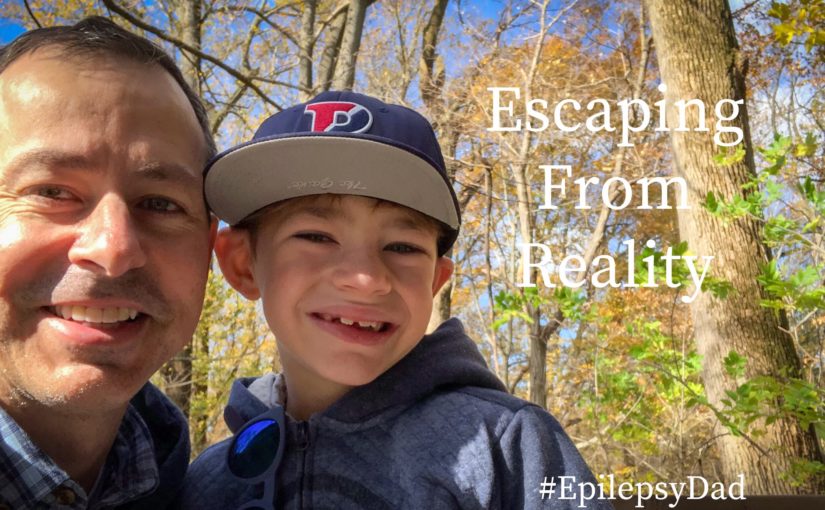
    When I was young, I was always looking to escape. I could read a book and see the scenery described on the page around me. I would read Spider-Man comic books and imagine myself, the awkward outcast, swinging from web to web through my neighborhood. And I would get so immersed in a video game that I wouldn’t notice that I was hungry or tired or that the sun was starting to come up and that I had to get ready for school.

    My ability for my imagination to transform the world around me helped me escape from the inescapable situation that was my complicated childhood.

    My son has that same gift. When we play hockey in his room, I think he sees a sheet of ice, feels the cold air around him and hears the support from his teammates on the bench and the fans in the stands. When we play Avengers, I think he sees our apartment as the city in smoldering ruins and himself as Captain America defending the citizens against whichever villain he has me portraying.

    I’m grateful he has that. My son’s childhood is differently complicated than mine was. Where mine was lacking, my wife and I try to provide for my son in abundance. But the challenges that he is facing because of his epilepsy and the myriad of complications that come with his diagnosis is not something we can remedy.

    In his imagination, those complications don’t exist. A seizure doesn’t prevent the game-winning goal or take down The First Avenger. The side effects of medication don’t slow down the action or the hero’s mind. Those are things for the real world. Those are things to escape from.

    As someone who needed a place to go myself, I’m empathetic and want to encourage the behavior. As he gets older, he can evolve his ability to craft a world to wrap himself in to shape the real world around him. That world is likely to be sometimes hard, sometimes cruel, and sometimes dark. But imagination and creativity have a way of shining a light into the darkness and illuminating the way.

    However he chooses to use his gift as he grows up and whatever form it takes, I hope he dares to shine that light on the world. Because I’ve watched it grow inside of him and have seen how it already impacts those around him. And it’s glorious.

    NEXT UP: Be sure to check out the next post tomorrow by Glynn Partington at Living Well With Epilepsy for more on epilepsy awareness. For the full schedule of bloggers visit livingwellwithepilepsy.com.

    And don’t miss your chance to connect with bloggers on the #LivingWellChat on December 6 at Noon ET.

  • Around The World

    Around The World

    I’ve always loved to travel. I lived in Germany when I was in the Army and I traveled to Japan and China in my single days. My wife and I honeymooned in Fiji and Australia. Almost as soon as we stepped foot back on American soil, I began looking for jobs in Sydney and Melbourne.

    When my son was younger, he took French classes and we planned to start with Montreal before exploring France and then, ultimately, starting a second career working in kitchens across Europe as a chef.

    Our move from Colorado to Philadelphia was part of that adventure. We left the relative safety of the whitewashed suburbs and moved to a diverse, gritty city and everything that brings with it. But as soon as we landed, my son started having seizures.

    In a way, I’m grateful for the timing because we are within ten minutes of one of the top children’s hospitals in the country. The people in that building saved my son’s life and continue to care for him. But now I feel tethered to that place. If we go too far away for too long, his seizures snap us back, sometimes violently, into their care.

    The daily seizures, the weekly doctor and therapy appointments, and the monthly medication refills make it impractical to look too far outside of our little bubble in the city. There isn’t a way to accommodate my son’s needs while chasing the dream of a life unbounded.

    But I’m not resentful. As much as that might have been the life I wanted, this is the life I have. I wouldn’t trade that life for the moments I’ve had and the lessons I’ve learned in this one.

    The dream of living in another part of the world seems so far away. But the reality is that we are exactly where we need to be.

  • The More Things Stay The Same

    The More Things Stay The Same

    The only thing that is constant is change. ~Heraclitus of Ephesus

    In many ways, our life is constantly changing. We meet new people and have new experiences. There are new projects at work. The changing season is bringing cooler temperatures and color to the trees. Things look different than they did a few months ago.

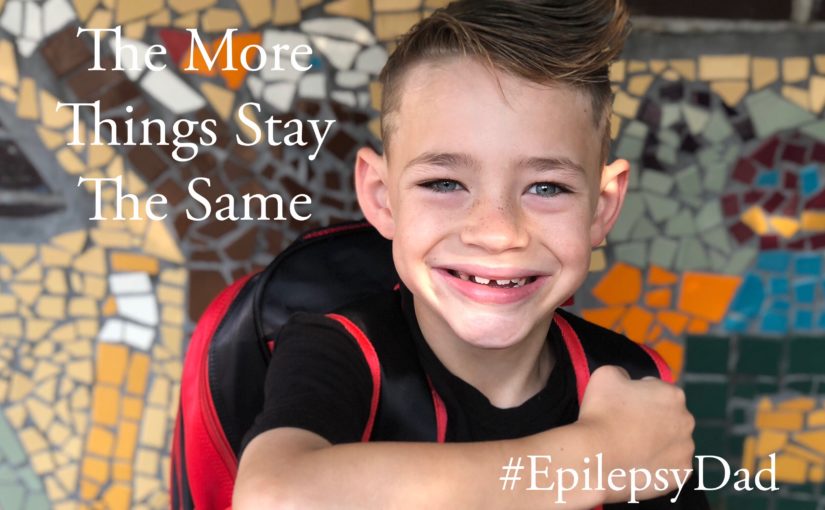
    My son started third grade and has a new teacher, a new aide, and is meeting new kids in his class. He’s in a different place than he was this time last year. He’s a year older. He’s on different medications with different benefits and side effects.

    The more things change, the more they stay the same. ~Jean-Baptiste Alphonse Karr

    But even with so many things changing, the world looks very much the same.

    In spite of the new medications, my son is still seizing. He still labors physically and mentally through the impact of those seizures and the many medications he takes to try to control them.

    In spite of the new grade, teacher and aide, the school is still not set up for him to succeed. He still cannot physically or mentally make it through the day. We’re having to explain and defend ourselves again this year, just like we do every year.

    In many ways, my son’s life changes so much that it’s unpredictable. But after a while, even that becomes expected. It becomes the same. A change for us would be stability. A change for us would be knowing what to expect from one moment to the next.

    But there is no way to control what that looks like. We could find ourselves stuck at the bottom instead of at the top. He could always be seizing. He could always be at the mercy of the cruel side effects of the medicine that keeps his brain from losing control. So, at least for today, I welcome change. Because, as long as things keep changing, there is always hope that things will change for the better.

  • Questions Without Answers

    Questions Without Answers

    Like many fathers, when my son was born, I had a list of things that I wanted to teach him. I wanted to be the sage, the guru that imparted to him wisdom drawn from my life experiences. I looked forward to the opportunity of leaving him feeling like his old man was a fountain of knowledge for all things. I longed for the bond that the transfer of knowledge would create between us.

    How do I tie my shoes?

    How do I throw a ball?

    How do I tell a joke?

    How do I ride a bike?

    How do I catch a fish?

    How do I program a computer?

    How do I ask a girl out on a date?

    How do I drive a car?

    But after he was diagnosed with epilepsy, I began to fear the questions that I knew he would eventually ask. I went from wanting to be the person he went to for answers to the person afraid to disappoint him when he asked questions for which I didn’t have an answer.

    Why is this happening?

    Will it ever go away?

    How do I live with epilepsy?

    These questions may be the biggest questions that he will ever ask because they are the biggest questions that I have ever asked. I’m also on a search for answers, but I don’t think I’ll have them before he poses the questions to me because not every question has an answer. We may never know why this is happening to him, but it is clear that this is our path. We may never know if it will go away, but we know that is here now. And we may not know how to live with epilepsy down the road, but we are doing the best we can today.

    Rarely does life go according to plan, but we are facing a life that can’t be planned. How my son is each morning, depending on seizures and side effects, determines what we can expect from the day ahead. It’s impossible to predict anything in the future when you can’t predict the next day.

    In the beginning, this uncertainty shut us down. I’m not sure it could have gone differently when my son was first diagnosed with epilepsy because we were fighting for his life. But even after he was stable, we were consumed with finding answers. After four years, it has become clear that there aren’t going to be any. But instead of letting that pull us back into hopelessness, we’re trying to allow it fill us with gratitude for what we do have. Because we have today, and for a time we didn’t think that we would even have that.

    I went into fatherhood expecting to show my son the things he needed to know. But maybe the most important thing I can show him is how to live without having all the answers.

  • Wall Of Limitations

    Wall Of Limitations

    This summer, my son participated in a week-long baseball camp. We knew it would be physically demanding so we spoke with the coaches before we registered him to make sure that he could rest and leave early if he needed it. It’s a phone call we have made before and will likely make many times in the future that serves two purposes. First, it helps us make sure that our son will be safe. And second, it identifies any places not willing to make accommodations for people who need them, which is not a place we want to be.

    My son’s nanny took him on the first day and the coaches welcomed him to the camp. He managed to stay for half the day but then took a three-hour nap when he got home. But he had fun and he made friends. The second day was much the same with a long nap after a shortened day.

    By the third day, he didn’t want to go. He was noticeably tired but he managed to make it out the door. His nanny coaxed him on to the field and, after almost thirty minutes, one of the coaches managed to finally get my son to participate. He left early again that day.

    On the last day of camp, we planned to let him stay all day because they were going to play a game. His nanny made sure he took frequent breaks and he made it through the day and finished the camp with a smile.

    The end of the camp coincided with the Little League World Series. I watched the grueling tournament and wondered, given how the camp went, whether my son could do anything like that. By now, I don’t have any grand vision of him playing in the major leagues, but I do want him to continue to play something that gives him joy and that makes him feel like a part of a team.

    It made me think that someday we’re going to run into a wall of limitations. We’ve faced small ones before, but we’ve managed to pass them mostly by watching our son climb over them. We’ve managed to keep our distance from larger walls by adjusting our path. We swapped hockey for baseball. We learned to work around his physical and endurance issues. But we haven’t been faced with consciously confronting the difference between possibility and probability. Potential versus practical. Fantasy versus reality. We haven’t faced the wall that was once on the horizon but is now uncomfortably close.

    And every day we are moving closer. It’s starting to block our view to the world behind it. I’m beginning to wonder what we will do when we reach it. Will it be too big and stop us in our tracks? Will it be too overwhelming and send us back the way we came? Or will we do what we have always done and follow our son as he finds a way to climb it, even though we know there will be an even bigger wall behind this one?