Category: parenting

  • The Importance Of Scoring Goals

    The Importance Of Scoring Goals

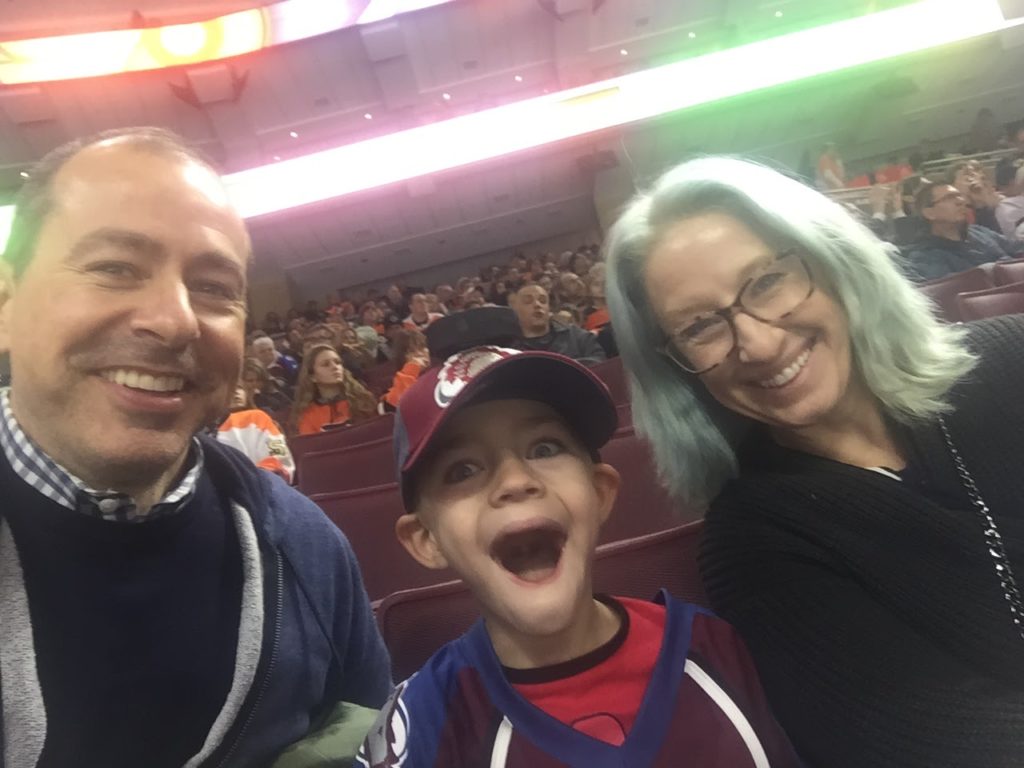
    Coming out of the womb, all my son wanted to do was play hockey. He started skating before he was two, and we played floor hockey almost every day, even when he had a broken foot. When he was five, before we left Colorado, we signed him up for an “Intro To Hockey” class. Watching him step on to  the ice (and fall) for the first time in full hockey gear was one of my favorite moments. I remember him skating around during warmups as if he was preparing for an NHL game. His energy was electric. Every time he made eye contact with me, I saw the look on his face that, as his father, I’ve strived to replicate ever since.

    The onset of his seizures changed our lives in many ways. Huge ways. Profound ways. But one of the hardest things for me to accept was taking away that look my son had when he was on the ice. When the seizures started, he would ask when he could get back to playing hockey. When he was at his worst, he stopped asking altogether. It was like taking air from him when he desperately needed to breathe. He needed to feel a connection to something to take away the fear and uncertainty. We couldn’t play floor hockey. We’d watch hockey on the television but I didn’t know if that was helping or hurting. They were pictures of a lost love that stayed just out of reach.

    After a long recovery, but amidst continuing seizures, he picked up his hockey stick again. Our epic battles of floor hockey returned. He skated, but it was inconsistent and only as his endurance, balance, and ataxia would allow. We found a coach to work with him off the ice on hockey skills. It was good to see him back in the world that he loved, but those activities were only parts of the whole. As he was able to do more of these activities, he started asking about ice hockey again. Every time he did, I still didn’t have an answer. It broke my heart.

    For two years, that question stabbed me every time he asked it. Finally, though, after grueling rehabilitation, we did something I thought was impossible. We signed him up for another hockey class. Granted, the first class didn’t go as planned. As I mentioned in a previous post, that first time back on the ice include a handful of seizures. But he stuck with it and he’s been going as much as his body and mind will allow. There were a few sessions he missed because he was too exhausted. But he kept going back, even when the drills were hard and as he struggled to control his body. He falls a lot, maybe not more than other kids, but every fall takes its toll more on him. Physically and emotionally, after practice he is spent, wasted and unraveled. But during class, he’s so, so happy.

    Last week, they set up nets and let the kids move the puck from one and to the other and shoot. Unless you’re a goalie (or even if you are), scoring a goal represents one of the defining moments for a player. Watch a young player in the NHL score his first goal and you can see that lifetime of waiting finally end. I felt the same way watching my son push the puck across the ice and take a shot. It seemed like a lifetime had passed since that class in Colorado. But after he took a shot, and after the puck slowly crossed into the net, he made eye contact with me. I saw the look that I wondered if I would ever see again.

    epilepsy dad hockey fatherhood

    During the car ride home that night, we watched the videos I took of him on my phone. “Did you see me score a goal on the backhand?” he asked. “Of course, ” I replied and restarted the video. We watched it over and over. Every time, I was more grateful than the last.

    Backhanded goal and celebration…

    A post shared by David Monnerat (@davidmonnerat) on

  • Talking To My Son About Epilepsy

    Talking To My Son About Epilepsy

    Imagine we are sitting at a table across from each other. I’m trying to teach you a complicated concept. Except I don’t understand the concept, either. And I’m also trying to teach it to you in another language. Except neither of us speaks that language. And the room we are in is pitch black.

    That is what it is like to talk to my son about epilepsy. It’s a topic that I didn’t have a reference for until it entered our lives. I’m learning what it means to be the parent of a child with a disability, but not what it means to have epilepsy. My son has a different perspective. He knows what it feels like to have epilepsy, but he doesn’t have the words to always share what he is going through. He doesn’t remember his life before seizures enough to describe the difference. So we fumble as we try to connect and create a shared experience.

    Occasionally, I’ll be able to pull something out of my growing knowledge bank to share with him. A few weeks ago, we strolled through Caesar’s Casino in Atlantic City. We passed a statue of Julius Caesar and I mentioned that he ruled the Roman Republic. I also mentioned that he had epilepsy. “He had epilepsy and he ruled the world, ” I said, “so you can do anything that you want to do.” I skipped the part about Julius possibly suffering from migraines and not seizures. The opportunity for bonding was more important than proven historical accuracy.

    There are flashes of a connection, but not enough of one. Epilepsy and seizures will affect him for the rest of his life. History lessons might be inspirational, but they don’t explain what he is feeling and why. They won’t build his epilepsy vocabulary. They might keep him hopeful, but they can’t predict what it will be like for him in the future. Nothing can.

    As a father, it makes me feel helpless. It’s my job to protect him. It’s my job to teach him the ways of the world. I think that if I do more research, if I learn more facts, that I’ll somehow be able to forge a path for him. If I can’t make him better, I at least want to make his life easier. But without knowing what he is going through, I’m never sure I’m doing the right thing. What I can do, and what helps me balance my frustration, is loving him and making him feel secure.

    Sometimes, there is light in the room. I’m able to see how brave he has become when he tries something new, talks to people, or jumps fifteen feet into a ball pit. I see how hard he works to do basic tasks and how much harder he has to work to do the things he likes doing. There is enough light to see that our family is around the table, trying to connect with each other. We’re still not speaking the same language, but there is enough light to see that we’re in this together.

  • Throwing It Back

    Throwing It Back

    We walked along the shore of Atlantic City. The beach was quiet with only a few other souls in view. The sun warmed the winter air to a comfortable temperature and cast stark shadows of the shells on the sand. The seagulls circled silently around us riding the current in the air. The waves rhythmically pushed themselves ashore. They darkened the sand to an almost black and erased the footprints that my son had left moments before.

    epilepsy dad feature throwing it back

    That morning along the beach, my son took to launching enormous clam shells back into the sea. The inhabitants had been the unwilling dinner guests of another sea creature or one of those circling seagulls. Now, their empty shells laid scattered along the shore. I watched as my son scurried along the sand, finding the biggest ones, and brought them up to the water’s edge. The ocean had given up the shells to the land and now my son was sending them back.

    epilepsy dad awareness seizure medicine throwing

    Since my son was young, he has always liked to throw things in the water. He liked to see how far he can throw something against the limitless backdrop of the ocean. There were no walls to bounce off, no cars to avoid, only infinity against which to test his strength. After he hurled an object into the sky, he would track it through the air until it reached its destination. Would it skip or would it splash? Either was acceptable, as long as it was far. On the really good ones, he’d turn to me and ask if I saw how far it went. Of course I was watching, I told him, but he was already looking for his next projectile.

    As I watched him throw shell after shell, I thought about the things I’d like to throw into the sea. I’d start by taking his seizures from him. Like a piece of paper, I’d crumble them up into a ball until they held their shape. I’d grip it like a fastball and wind up with enough torque that, when I let go, the seizures would disappear over the horizon. I’d do the same with his medicine and their side effects. His learning and attention issues would be the next to go, followed by his fatigue and ataxia. Over and over, I’d crush these afflictions into dense spheres and throw them with all my strength. Whether they skipped or splashed, I only want them far away from my son, somewhere at the bottom of the sea.

    epilepsy dad feature throwing it back

  • The Appearance Of Being Strong

    The Appearance Of Being Strong

    We’re more than two and a half years into our journey. For a third of my son’s life, he’s lived with seizures. It’s getting harder to remember the time before them. The carefree days before hospitals and therapies seems more like someone else’s life.
     
    Our new life doesn’t feel like it is getting any easier, even being so far into it. There is no resolution. There are no reasons. There is no consistency except for the looming threat of another seizure. It is chaotic to manage his diet, his medicine, and his appointments. There is a never ending stream of complexities in our lives. On the good days, it feels like we’re barely treading water. On the bad days, it feels like we’re drowning.
     
    We’ve met a lot of families that have been dealing with seizures much longer than we have. I look at them as if they are the strongest people in the world, dealing admirably with such an impossible path. They somehow figured out how to manage the unmanageable. Their perspective keeps them sane and grounded and able to function in such a complex system. I’ve often wondered if we would find that place, and if someone on the outside would think the same thing about us.
     
    I keep waiting for a switch to flip, for that “a ha” moment where the mystery of how to navigate this life is explained. So far, it hasn’t happened and it’s frustrating. I’m a smart guy. I figured out how to ride a bike, drive a car, program a computer and build a robot. But there is no pattern in what is happening. There’s nothing for my mind to organize around and to sort out. We are in a constant state of reaction with very little that we can control.
     
    The lack of control and my inability to figure it out makes me feel like we’re not there yet. People around us use words like “strong”” and “brave” but I can’t let that in because I don’t believe it. Every seizure, every outburst, every failed medicine, every closed off path, every false hope. As much as I try to hide their impact from the outside world, it feels as if I wear them as visibly as I wear clothes. I’m only forcing myself to do what I need to do for my son and my family.
     
    But, maybe, that’s what everyone else does, too.
  • Getting Unused To The Sound

    Getting Unused To The Sound

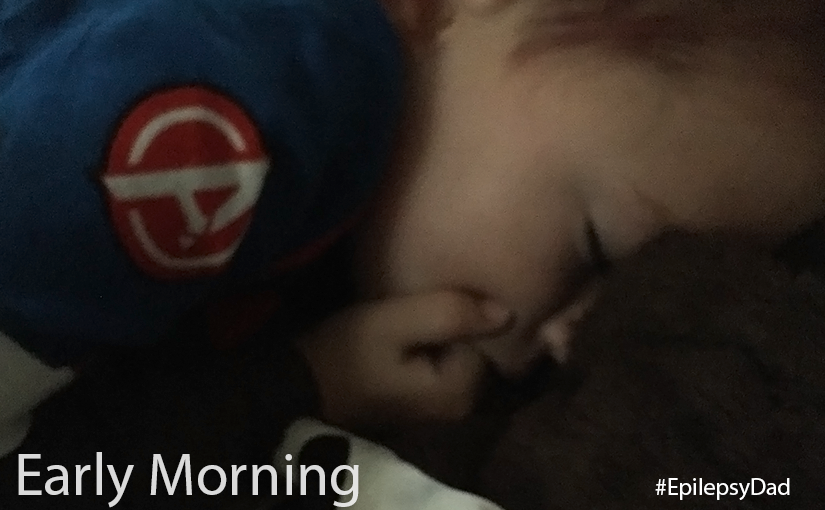
    We’ve lived almost every day of the last two and half years with the sound of my son having a seizure. Usually, in the early morning, the distinctive sound my son creates as his body tenses and contorts echoes through the halls until it reaches my ears and stirs me from my sleep. For two and a half years I have been on guard, listening for that sound that served as an alarm calling in the dark. I’ve spent most nights periodically waking to watch and listen to the video monitor. This has been our routine. This has been our life.
     
    When his seizures started, I would rush to his room with every seizure and lay with him until he fell back to sleep. Sometimes I would catch another seizure when it started. It was somehow comforting being there with him when they happened, from beginning to end. To hold him, to rub his head, and to let him know that I was there and that it would be over soon and that he would be okay.
     
    As time went on, my son started putting himself back to sleep before I could reach him. I started watching the monitor as he came out of a seizure to see if he needed me. More and more, he would simply turn over, pull the blankets back up to cover his body and fall back to sleep. As much as I liked being there with him during a seizure, the new arrangement gave me a few extra minutes of sleep.
     
    In the last month, we’ve also been able to string together (we think) a few seizure-free days in a row. I say “we think” because some of his are so short that they are easy to miss, especially in the middle of the night. But on a few of those nights, he was with us and he did not seize. He even had his first seizure-free week since they began.
     
    I felt like we turned a corner. We made the most recent change to his medications a few weeks before those seizure-free days and I almost let myself believe we had solved the riddle. But then my son got sick and we were again visited by our most unwelcome guest. He rides such a fine line between seizing and not that even a common cold can undo a streak.
     
    Hearing seizures in the middle of the night had become such a part of our routine that, when they stopped, it was easy to fall into the trap of thinking that they were gone. I stopped thinking that a life without seizures was possible, but when we had a week without them, I was too quick to assume that they wouldn’t come back. I felt as if we had been lifted from this unforgiving place. When they did come back, I fell from such a great height that the impact nearly crushed my spirit.
     
    As grateful as I was for those days without seizures, they tugged at my desperation. They opened me up at my seams and stuffed me with false hope before closing me off. Now I’m pulling at the stitches trying to free myself from unrealistic expectations.
     
    The reality is that the sound of a seizure will be a part of our acoustic landscape as long as our son is living with us. Even if we see another stretch of seizure-free days, the threat of another will always be there. There is no escaping its reach, no getting unused to the sound. The only thing I can do is respond when the alarm sounds, which I will do whenever I am called.