Tag: future

  • Uncertainty, Fear, and Hope

    Uncertainty, Fear, and Hope

    “It’s not the unknown itself that paralyzes us—it’s our fear of what it might hold.” – Unknown

    In life, there is always uncertainty.

    Will my car start? Will there be traffic? Will I make it in time?

    Is this milk bad? What will happen if I drink it anyway?

    Most of the time, we aren’t aware of how much uncertainty there is. We focus on the present moment and the task at hand. Our awareness and perception are constrained to what is in front of us.

    That’s a good thing. It would be terrifying if we were constantly aware of just how much uncertainty there is. We’d be paralyzed by fear—fear of the unknown, of what the future might hold, and of how little control we truly have.

    “When everything is uncertain, we crave control. But clinging to certainty can keep us from growing.” – Unknown

    Sometimes, though, uncertainty is impossible to ignore. Sometimes, it compounds until it becomes big enough to have a gravity of its own. And sometimes, it collapses on itself like a black hole that consumes every other thought.

    Uncertainty about my son’s future. Uncertainty about my career. Uncertainty about the health of a loved one. Financial uncertainty. Relationship uncertainty. Each can be daunting by itself and occupy my thoughts. But, together, there can be nothing else. No other thought can escape.

    When uncertainty dominates our thoughts, it can be overwhelming. In these moments, it’s easy to focus on the negative, like the discomfort of not knowing and the worst-case scenarios that could unfold.

    I’ve always tended to wait for the other shoe to drop, focusing on the rare moments when it does rather than the many times it doesn’t. This pattern is known as negativity bias—the tendency to give more weight to negative experiences than to positive or neutral ones. Even when good outcomes are more common, the few bad ones loom larger in my mind, especially during times of uncertainty, when the unknown consumes my thoughts.

    It’s hard to remember that uncertainty isn’t always a bad thing because it’s difficult to imagine positive outcomes when all you see is the unknown.

    Uncertainty is the refuge of hope.— Henri Frederic Amiel

    I like this quote because it shifts perspective. While uncertainty can be unsettling, it also allows space for hope. The unknown holds the potential for something better, new opportunities, healing, and change.

    I try to remind myself of this when fear takes hold. When everything feels uncertain, there is still room for hope. And sometimes, hope is enough to keep moving forward.

  • The Real World

    The Real World

    This is the true story…of seven strangers…picked to live in a house…(work together) and have their lives taped…to find out what happens…when people stop being polite…and start getting real…The Real World.

    Around the time I graduated high school, MTV launched a show called The Real World. The first season followed seven young adults living together in a New York City loft, documenting their interactions, conflicts, and discussions about race and identity. It was marketed as an unscripted glimpse into young adulthood, but in reality, The Real World was anything but real. The show was heavily edited, and its cast was carefully selected to generate conflict and drama. The environment was artificial—a manufactured version of adulthood designed for entertainment rather than truth.

    Lately, I’ve been thinking about that contrast between reality and expectation as we navigate our own version of The Real World—helping our son transition into adulthood. We’re working with a transition counselor to understand his path forward, and it’s forcing us to confront some hard realities about his future.

    This process has resurfaced unanswerable questions and concerns about how much support our son would need to get through his daily life. Will he remember to take his medication? Does he know when to do laundry? Will he remember to turn the stove off? Would he be able to finish chores and tasks without getting distracted?

    The scripted version of adulthood—the one where you turn 18, go to college or get a job, and move into your own place—isn’t the one we’re working with. Instead, we’re piecing together a different kind of future shaped by his abilities, challenges, and the resources available to help him live as independently as possible.

    The good news is that there are benefits and programs designed to support people like him. However imperfect, there are systems in place that can help him build a life. A life where he can find his own sense of independence, identity, and path.

    The bad news is that these systems and benefits are the same ones under attack by the current administration. Social Security, Medicare, Medicaid, the Department of Education, and support for non-profits are all in danger of being eliminated or losing some or all of their funding. The uncertainty of the future of these vital support programs directly correlates with the uncertainty I feel about my son’s future.

    Ultimately, this is the real world that I am thinking about. Not the one made for television, but the one that exists where there are no cameras. A world that is not made for people like him. A world where, one day, he’ll have to live without us, whether those support systems exist or not. What that world looks like and what his quality of life will be in that world is what we are fighting for.

    It’s not scripted.

    It’s not edited for drama.

    It’s just real.

  • Rock On

    Rock On

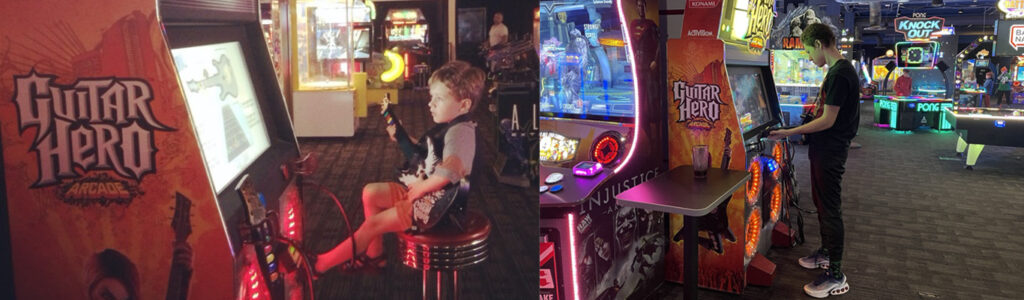
    The image above was 10 years in the making.

    The photograph on the left was taken in July 2014. We were in Philadelphia ahead of our eventual move from Colorado. My wife and son had a long week of exploring and house hunting, and we thought we’d unwind and play games. About an hour after that picture was taken, we’d be standing in the lobby waiting for a taxi and watching our son have his first seizure.

    Over the next 10 years, we’d see our son have countless seizures. We’d have many nights where we thought we would lose him. We would spend months in the hospital saving his life and then years trying to rebuild what was damaged. We would struggle to find his place in the world.

    The photograph on the right was taken at Dave & Buster’s a few weeks ago after our son’s last school day before winter break. As I walked around the corner and saw him pick up the guitar, I had the image of my present-day and my son 10 years ago, like two different realities, crashing together in my mind.

    While we’ve had struggles and challenges in the last ten years, the significance of that moment was that we’ve also had successes and accomplishments. Our son is 15 now, and we’ve had so many years we weren’t sure we would get. He plays baseball, enjoys gaming and streaming, and has friends. He’s in a school for kids like him, which gives him a place to learn and grow.

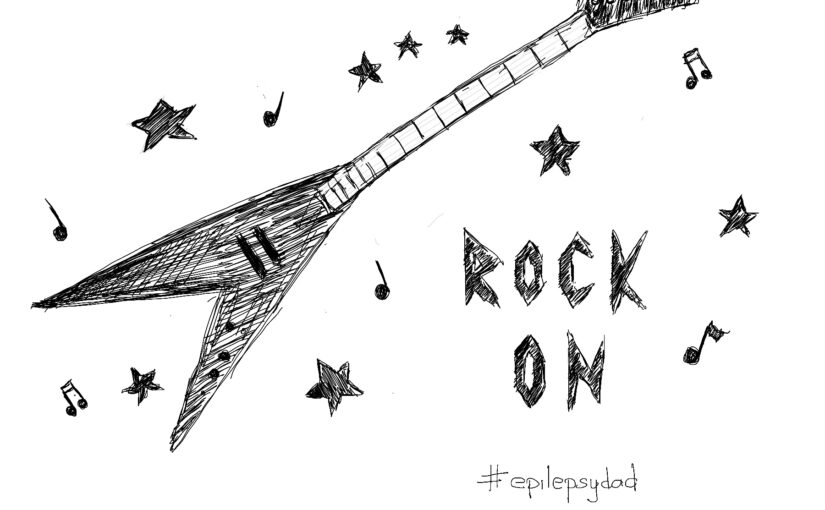
    When the picture on the left was taken, we didn’t appreciate how little knowledge and control we had over the future. Later that night, any vision we had for the future was shattered. The picture on the right reminded me that we can never predict the future. We can only learn to embrace every moment, victory, and opportunity to pick up the guitar and rock on.

  • Discovering What’s Next

    Discovering What’s Next

    Our son is officially a 9th grader, adding to our list of milestones and events we weren’t sure we would see.

    We are very fortunate to be able to start high school in the best way possible. The school he has been at since 6th grade offers a transition year, which we are taking advantage of with the support of our school district. That means he will have the same teachers, peers, and environment to continue his journey for another year. Especially with the looming surgery, recovery time, and uncertainty with his tolerance for calibrating the brain stimulator, keeping him in a place where he is comfortable and cared for is a gift.

    This is going to be a year of changes. Unless higher grades magically appear, this will be his last year at the school, and his peers who have been concentrated at his school will find high schools in their home districts. This will likely be his last year of baseball, as the level of play and competition at the next level may not be something he can manage. His peers will get their learner’s permits and start driving, something he won’t be able to do while he is still having seizures.

    No one knows what is on the other side of these changes. I am sure he will find friends among his new peers and that other interests will replace baseball. While he won’t learn to drive with his peers, there will be other rights of passage to conquer and other ways to grow.

    But many of these changes are still on the horizon. He has 9th grade to look forward to and another baseball season. He has his school, teachers, peers, and friends. He has and will always have his family. And together, we can navigate these changes and discover what’s next.

  • Dream Big

    Dream Big

    The other day, I was driving my son to music camp. The camp was at the same place where he takes his drum lessons but, rather than private lessons, the camp groups the kids into bands that perform at the end of the week.

    When I asked my son if he liked the band experience, I expected his response to involve the difference between lessons and performing or what it is like to play with other musicians. Instead, his response centered around wondering if he would get on the Wall of Fame that the school had of previous students.

    I wasn’t entirely surprised by his response. Very often, his goals involve a championship. When we talk about hockey, he wants his name to be on the Stanley Cup. When we play Fortnite, he wants to be on the leaderboard or have his own skin like the influencers have. He talks about subscribers and likes for his Twitch feed and YouTube channel.

    As a kid, I remember being young and obsessed with getting my initials on every video game I touched to leave my mark on everyone who would play the game after me. At one point, my initials filled the high score screen of a game called Mr. Do that I played every day while waiting for the school bus.

    I played basketball in the driveway and imagined the next shot was a buzzer-beater to win the championship, and I tossed balls in the air and pretended that I faced a full count and needed a hit to win the game. Creating the ultimate clutch scenario and delivering is the dream of many would-be heroes, even those of us who were not destined for sports greatness. It added drama to a sport or game that I loved to play.

    I’ve heard interviews with professional athletes who had the same dreams, except they focused on achieving them. Even at a young age, they would spend hours working on their game, taking slap shots, making free throws, or swinging a bat. They aimed to become a professional athlete and help a team win a championship by delivering in that clutch moment.

    Whether it’s video games, sports, or music, that desire to be the best can be a great motivator. But what happens when achieving that dream becomes the bar? What if whether a dream is achieved becomes the only measure of worth?

    I love that my son has big dreams. For everything he has been through and everything he struggles with daily, he could have just as easily become a victim of his situation and have no dreams at all. But I’m afraid that if he doesn’t achieve his dream, he will resent the experience rather than be proud of himself for what he did accomplish.

    I realize those are my feelings and may not be his. It breaks my heart that his chances of playing in the NHL are minuscule, and because I’m disappointed for him, I’m expecting him to be disappointed, too. But my feelings are based on my frustration and anger at what his condition has taken from him, which probably results in a higher degree of disappointment, just like it results in a higher degree of admiration for what he can accomplish.

    Ultimately, my job as his parent is to let him have his dreams and make it okay, whether he achieves them or not. My job is to instill in him the ability to be proud of himself for his accomplishments and to encourage him to love the experience, the sport, and the time he could do what he enjoys. It’s my job to show him that there is a sense of accomplishment in doing something and then working at it to improve and become the best you can be, even if it doesn’t come with a trophy or picture on a wall.

    I’m a big believer in dreaming. If you don’t dream it, you can’t become it. – Magic Johnson

    Dream big, pal.